
Merchant Channel Details
Table of Contents
1. Feature Guide
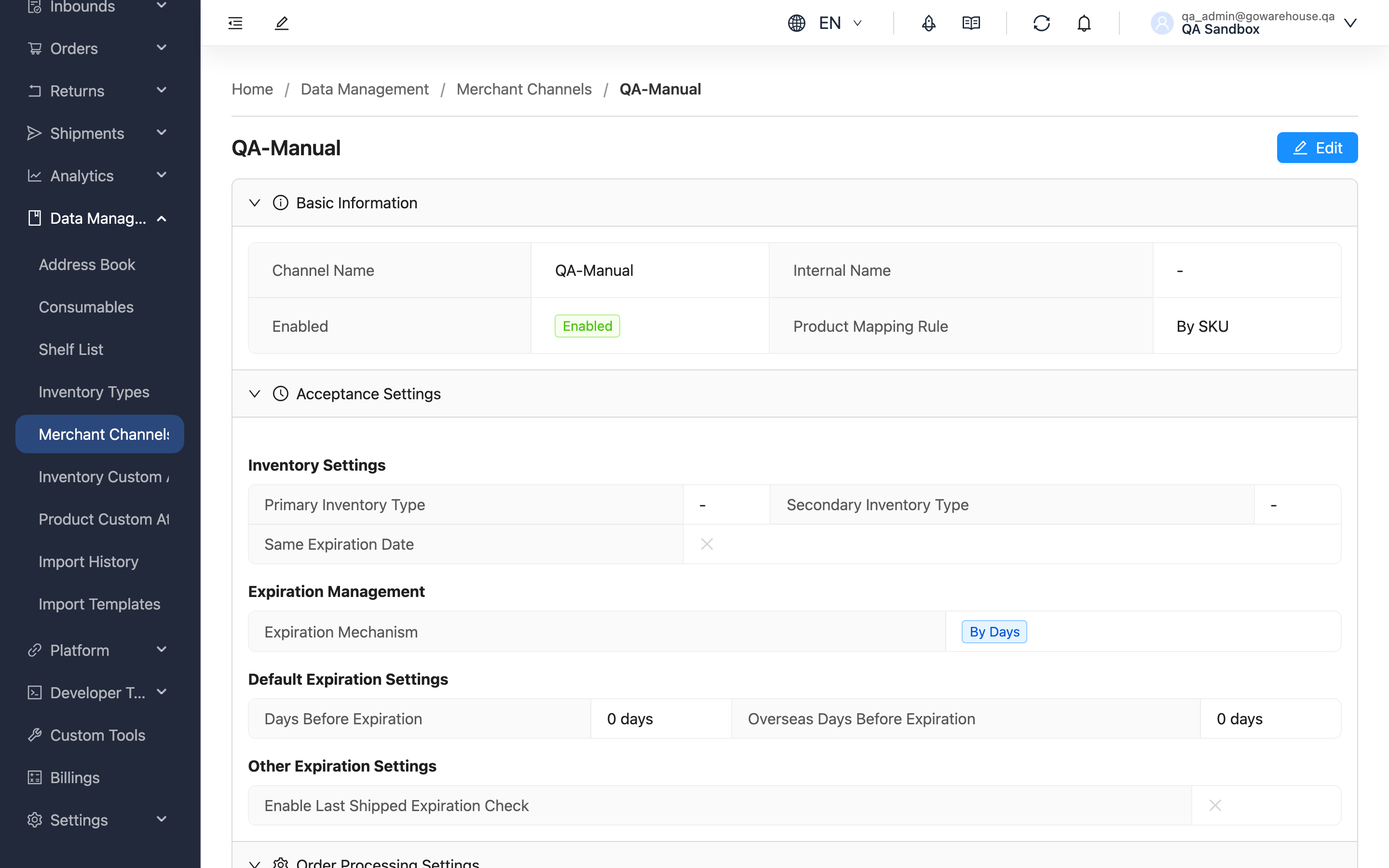
This page lists all of a channel's shipping rules in one place — basic info, which inventory type to ship from, expiration requirements, and order automation settings. When you suspect a channel's order allocation isn't behaving as expected, or want to confirm the current state before making changes, you can review everything here, then proceed to edit once verified.
Quick Jump: Basic Info | Acceptance Settings | Order Processing Settings | Action Buttons
1.1 Basic Info
| Field | Description |
|---|---|
| Channel Name | The channel's name |
| Channel Code | The channel code used with external systems; both import and export rely on it |
| Enabled Status | Whether the channel is currently enabled |
| Product Mapping Rule | How order items map to inventory (By SKU / By Barcode) |
1.2 Acceptance Settings
Inventory Settings
| Field | Description |
|---|---|
| Primary Inventory Type | The inventory type used first when shipping |
| Secondary Inventory Type | The backup inventory type used when the primary is insufficient |
| Same Expiration Date | Whether identical products in the same order must come from the same expiration batch |
Expiration Management
| Field | Description |
|---|---|
| Expiration Mechanism | No Expiration Control / By Days / By Ratio |
| Days Before Expiration | Minimum remaining shelf life in days for domestic shipment (shown when mechanism is By Days) |
| Overseas Days Before Expiration | Minimum remaining shelf life in days for overseas shipment |
| Expiration Ratio | Minimum remaining shelf life ratio for domestic shipment (shown when mechanism is By Ratio) |
| Overseas Expiration Ratio | Minimum remaining shelf life ratio for overseas shipment |
| Tiered expiration rules | Tiered acceptance standards applied by the product's original shelf life, split into domestic and overseas columns |
| Enable Last Shipped Expiration Check | When on, the same product shipped to this channel can only have equal or longer shelf life |
1.3 Order Processing Settings
| Field | Description |
|---|---|
| Inventory allocation policy | How stock is allocated when inventory is insufficient, in one of three modes: "Full allocation (all-or-nothing)" releases the stock and marks the whole fulfillment short as soon as any line is short; "Partial allocation (hold out-of-stock lines)" locks the full quantity of lines with stock and holds short lines as whole lines waiting for replenishment; "Partial allocation (auto-split backorder)" lets a line lock part of its quantity and splits the short portion into a backorder fulfillment. When the "Use Merchant Default" tag is shown, the mode displayed next to it is the account-level default being followed |
| Fulfillment Lot Policy | How to handle shipment when batch attributes are unspecified; inherits the merchant setting if unset |
| Auto Complete Fulfillment | Whether the fulfillment order auto-completes after picking |
| Auto Recheck Inventory | Whether out-of-stock orders are automatically rechecked when inventory changes |
| Recheck Inventory Priority | Smaller number = higher priority; determines the order in which out-of-stock orders are reallocated |
The bottom of the page also shows the channel's creation and last update times.
1.4 Action Buttons
| Button | Description |
|---|---|
| Back | Return to the Sales Channels List |
| Edit | Open Edit Sales Channel to modify settings |
2. FAQ
Quick Jump: FAQ | Important Notes
2.1 FAQ
▪ Why isn't this channel's order allocation behaving as expected?
It's usually related to the acceptance settings. Review the expiration mechanism and the primary/secondary inventory types to check whether an overly strict expiration threshold is filtering out stock, or whether the primary inventory type is empty with no secondary inventory type set. Once confirmed, you can edit to adjust.
▪ What does "Use Merchant Default" mean for "Inventory allocation policy"?
It means this channel hasn't set its own rule and follows your account-level default; the tag is shown together with which of the three modes that default is, so you don't have to go back to the account settings to check. To give this channel its own rule, pick a mode on the edit page; to go back to following the account default, clear the field.
▪ Why don't I see the "Edit" button?
You may not have permission to edit this channel; contact your administrator to confirm.
▪ When do changes take effect after saving?
Changes take effect immediately and apply to subsequent orders; existing orders keep their original allocation results. You can create a test order to confirm allocation matches expectations.
2.2 Important Notes
⚠️ Important Reminders
- Expiration and inventory type settings directly affect allocation results; assess the impact on shipping before adjusting.
- Tiered expiration rules take precedence over the default expiration days/ratio above.
3. Related Features
| Feature | Description | Link |
|---|---|---|
| Sales Channels List | View all channels | Go |
| Edit Sales Channel | Modify channel settings | Go |
| Order List | View order allocation and shipping results | Go |