
Order Details
Table of Contents
1. Features
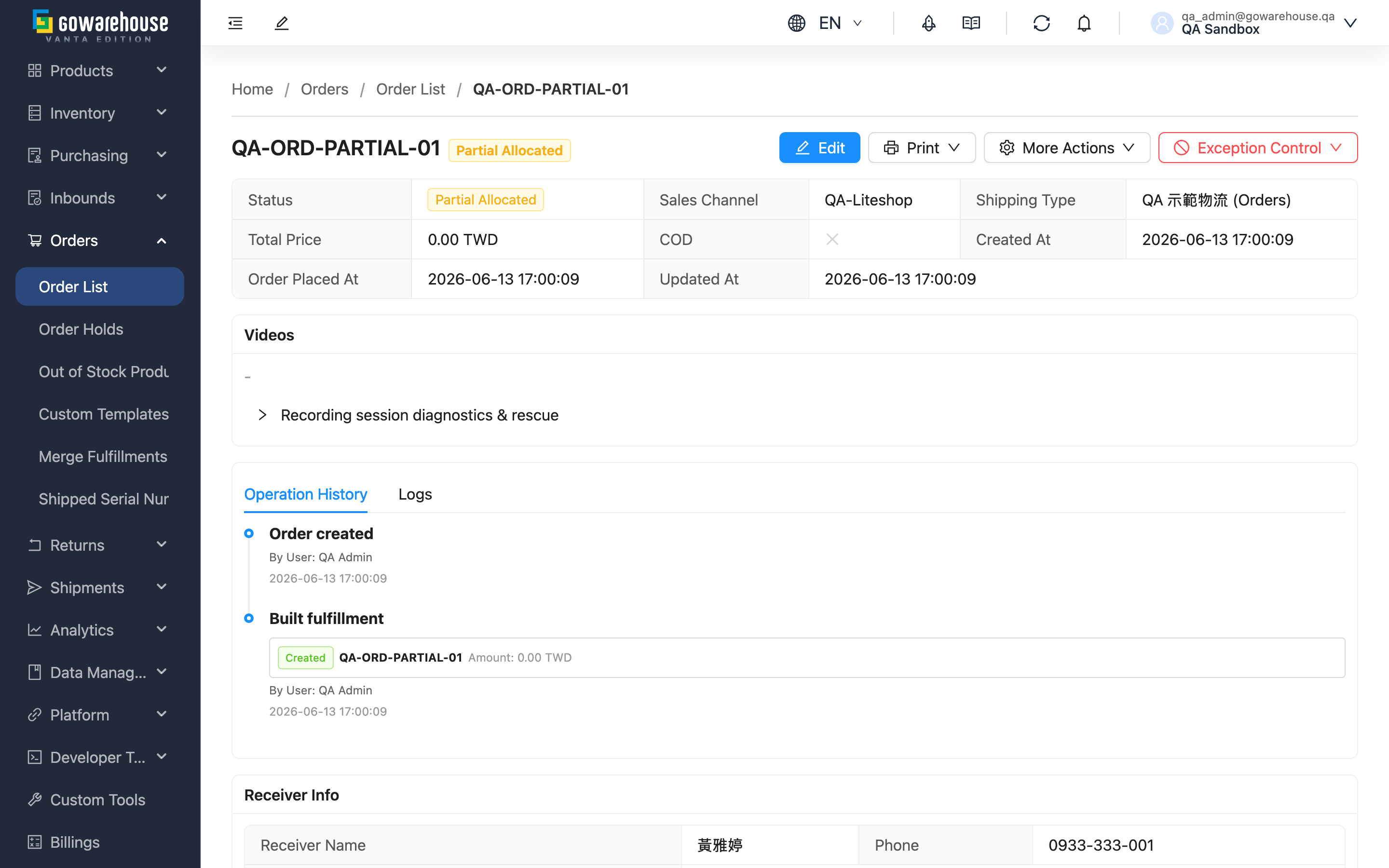
The order details page gathers the complete picture of a single order: what the customer wants, how far the warehouse has gotten, and what was shipped. Here you can view receiver info and amounts, track the progress of every fulfillment and shipment, and run actions such as edit, hold, and cancel. When a customer calls asking "where is my package", this page gives the full answer.
Quick jump: Order Info | Items & Fulfillments | Available Actions
1.1 Order Info
The top of the page shows the order's basic data: receiver info such as "Receiver Name", "Phone", "Full Address", along with "Total Price", "Shipping Type", and "Sales Channel". If the order was imported from an e-commerce platform, the "EC Account" source is shown; when that field carries a "Not linked to platform" tag, the order still has an e-commerce account attached but no longer exchanges data with the platform — see Copied orders are no longer linked to the platform.
If the order is currently held, a hold warning appears at the top of the page, listing each hold's reason and who placed it, helping you decide how to proceed.
If the platform has canceled an order but a restriction such as an existing shipment on its shared fulfillment prevents cancellation here, the system retains or creates a hold, including for out-of-stock orders. Restocking or rechecking inventory does not release the hold; the shared fulfillment remains blocked from shipping. Confirm the cancellation failure with your warehouse before releasing the hold.
1.2 Items & Fulfillments
The details page presents the order's various aspects in tabs:
| Tab | Content |
|---|---|
| Items | The products in the order, each item's "Expected Quantity" and "Shipped Quantity", inventory status, plus the allocated batch and expiration date |
| Fulfillments | Each fulfillment under the order and its shipment status and tracking number. A fulfillment represents "the contents of one shipment" and is the document the warehouse actually works from |
| Parcels | Contents, consumables, and packing time of packed parcels; a parcel the system generated automatically (created when a fulfillment ships without ever being packed) has no consumables — that is normal |
| Serial Numbers | Serial numbers of shipped products (if the product has serial-number management enabled) |
| Value Added Services | Value-added service items and fees included in this order |
| Attachments | Order attachments, including manual uploads and files brought in with the import batch; clicking a file name opens it in a new tab, and if your browser blocks pop-ups a message asks you to allow them and click again |
The relationship between orders and fulfillments: An order is the customer's shopping list, recording what the customer wants; a fulfillment is the shipping work order the warehouse builds from the order, recording what the warehouse actually ships. One order may be split into multiple fulfillments due to multiple warehouses or shipping in-stock items first, or merged with other orders into one fulfillment. So an order's status is in fact the aggregate of all its fulfillments' statuses.
Lower on the page is the order's history, listing each step — creation, edits, holds, shipping — in reverse chronological order for traceability.
Split and merge fulfillments
With order write permission, you can act on eligible fulfillments in the "Fulfillments" tab.
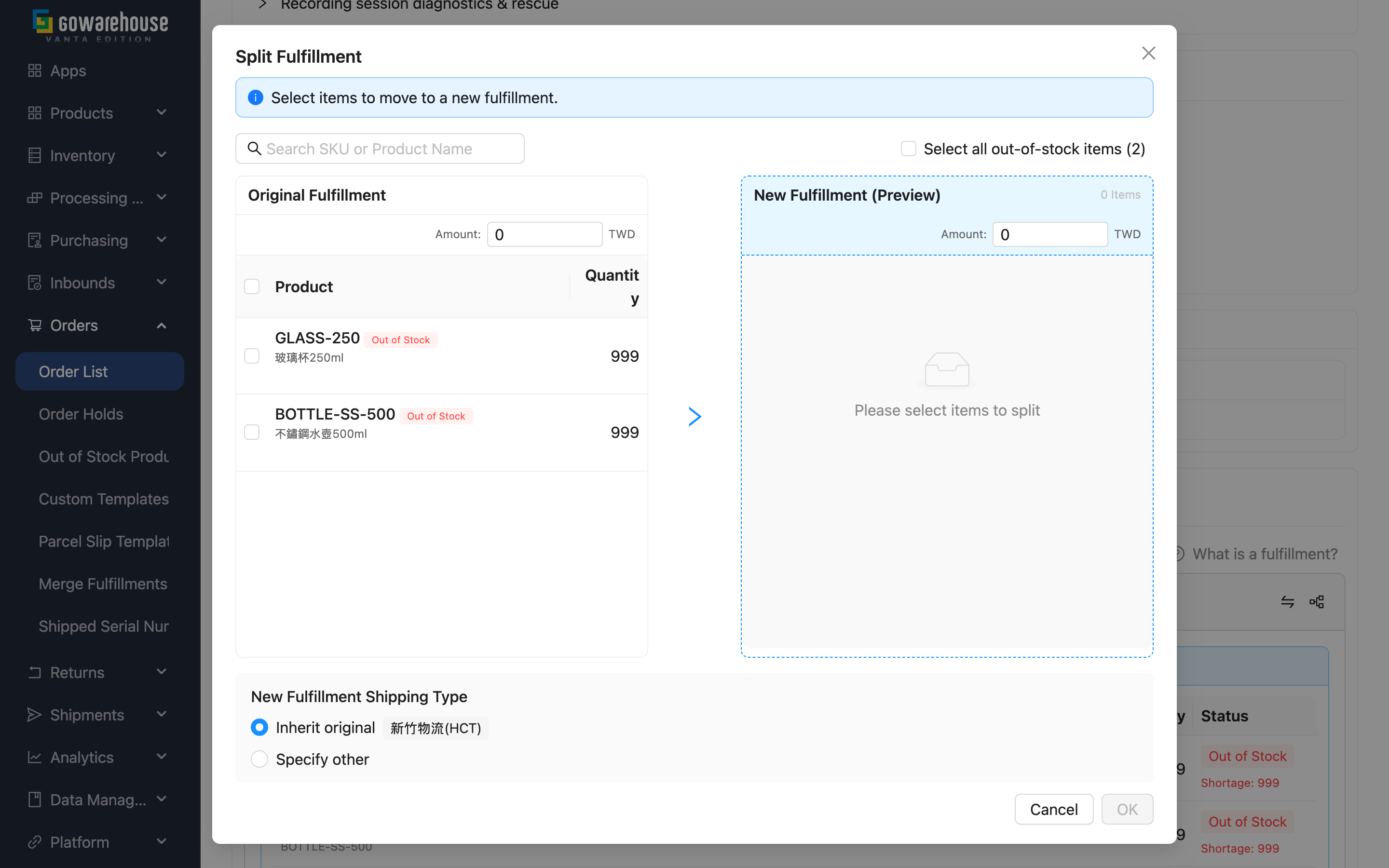
Split: Click "Split" on a fulfillment, then select the products and whole-number quantities to move to a new fulfillment. At least one unit must remain in the original. You can choose a destination warehouse and shipping type available to the merchant. Review the amounts for the new and original fulfillments before submitting. If you edit the amounts, their sum must equal the original fulfillment total. Submission is disabled while the preview is loading or has failed; follow the prompt to correct the selection or retry.
Merge: Select at least two eligible fulfillments and click "Batch Merge". They must share the same currency, shipping type, and eligible status (allocated or out of stock). The system consolidates their items and amounts into one of the selected fulfillments. For a cross-warehouse merge, review the destination warehouse shown in the confirmation dialog before proceeding.
Cash-on-delivery fulfillments, platform-exclusive shipping types, and fulfillments already in picking or shipping are ineligible. Splitting also checks that all associated orders remain eligible. Buttons reflect current eligibility, and the system checks the status again when you submit. After success, the fulfillment list refreshes and the action is recorded in the order history.
1.3 Available Actions
The action buttons on the page show or hide automatically based on the order's current status — only the actions currently allowed appear.
| Action | When available / Effect |
|---|---|
| Edit | Enter Edit Order. Cancelable, canceled, or "Partial Shipped" orders can be edited; orders already in picking (fulfillment is "Processing") or fully shipped cannot; orders in merged fulfillments must first be removed from the merge |
| Remove from merge | Remove this order from all shared fulfillments; other orders and inventory reservations stay unchanged. Available for merged, splittable orders; requires order write permission |
| Hold Orders | Pauses shipping for orders in "Pending Allocation", "Allocated", "Processing", "Partial Shipped"; an order can have only one hold at a time |
| Cancel | Cancels the order and releases reserved inventory; "Partial Shipped" and fully shipped orders cannot be canceled. For merged shipping, only the canceled order's items are removed; other orders keep their original fulfillments and stock reservations. See Canceling merged orders for restrictions and resuming |
| Resume Orders | Resumes a "Canceled" order; the system rechecks inventory |
| Check Stock | Rechecks inventory, used after restocking to try to release out-of-stock orders |
| Create Return | Creates a return order for this order |
| Duplicate Order | Open a new order from this one's delivery info and item details, commonly for resending; available in any status. You type the new order number yourself in the confirmation dialog, stock is allocated again, and the original order is untouched. A copy of a platform-imported order is no longer linked to the platform — see below |
| Print / download the shipping detail PDF |
⚠️ Copied orders are no longer linked to the platform
Once an order imported from an e-commerce platform is copied, the copy leaves the platform behind and becomes the warehouse's own order:
- Later platform-side changes land on the original order only: when the buyer changes the address or items on the platform, or the platform cancels the order, the sync updates the original order and never touches the copy. Changes to the copy have to be made in the system.
- Shipping the copy does not report the tracking number back to the platform: the original order still reports as usual; the copy does not. This prevents two orders pointing at the same platform order, where the one shipped later would overwrite the earlier tracking number. Because no request goes to the platform either, a copy that still carries a platform-exclusive shipping type (one the platform ships for you) cannot obtain a tracking number at all: switch its shipping type to one of the warehouse's own carriers, request the tracking number again, and then pass that number on to the buyer yourself.
- The copy still carries the same e-commerce account: platform-specific settings such as the shipping type need it to resolve their names. The "EC Account" field gains a "Not linked to platform" tag so you can tell it apart from orders that are still syncing; orders still linked to the platform do not carry this tag.
Shopee virtual phone numbers
When Shopee provides both a virtual phone number and a query code, "Phone" shows the complete pair separated by a hyphen, for example 0928000888-54478768. If only one part is provided, that part is retained; if neither is provided, the recipient phone from Shopee is used. Newly generated KerryTJ labels retain the complete phone value.
Existing orders are not corrected immediately. On the next fetch, the Shopee order must still be ready to ship and the local order must still allow platform updates. Orders being picked or in a state that blocks updates retain their data. Resynchronization also imports other editable order data from the platform; existing shipments block updates that require rebuilding fulfillments under the usual safeguards. Check the phone and fulfillment progress before handling an older order. Downloading an existing label returns the original file; correcting the phone does not automatically replace that label.
Platform prices
When available, "Supply unit price" appears separately from Unit Price; see Supply unit price. momo imports the platform purchase price. Yahoo SCM separates supply and selling prices and calculates the order total from selling prices multiplied by quantities. PChome transfer orders provide no consumer selling price, so selling and original prices stay blank and the order total is 0. The supply price remains available here and is not included in the default packing slip. PChome imports are rejected when the selected carrier requires a minimum order amount.
Existing orders are not automatically backfilled. Orders that still allow platform updates receive the new mappings when fetched again; a resync caused only by the price-field mapping change preserves existing items and manual product mappings, quantities and notes. Changes to the order total still rebuild eligible fulfillments; existing shipments block the update and produce a sync failure under the usual rules. Frozen orders retain their existing data. Platforms that do not provide a supply price leave it blank. When the platform recipient data itself is unchanged, a price-mapping-only resync also preserves manually corrected addresses, phone numbers, recipient names and notes. Actual platform changes still follow the existing synchronization rules.
1.4 Order App actions
When an installed App provides an order detail action, its button appears at the top of this page. You need order read and write permissions. The app receives the current order when it opens. Its features may also use other data within its granted permissions; review the action shown by the app.
Apps with a confirmation dialog show the proposed action before submitting it; cancel closes the dialog. After saving, the App can refresh the order page and close the dialog. If saving succeeds but refreshing fails, follow the App prompt to retry the refresh or reopen the order. A revoked permission or uninstalled App prevents further actions from the old window.
1.4 Invoices
“Invoice details” at the top of this tab shows the order’s invoice instructions, even before an invoice exists. To change them, select “Edit” beside the heading; this works for shipped and canceled orders too. Only the invoice instructions are saved: fulfillments are not rebuilt and issued invoices are not overwritten. See Edit Order for the field rules.
In the order instructions above, Carrier type, Carrier ID, and Donation code appear only when the merchant’s organization country is Taiwan, regardless of the recipient country, currency, or interface language. For other or unspecified countries, the tax field is labelled Buyer tax ID. Hiding fields does not clear saved values.
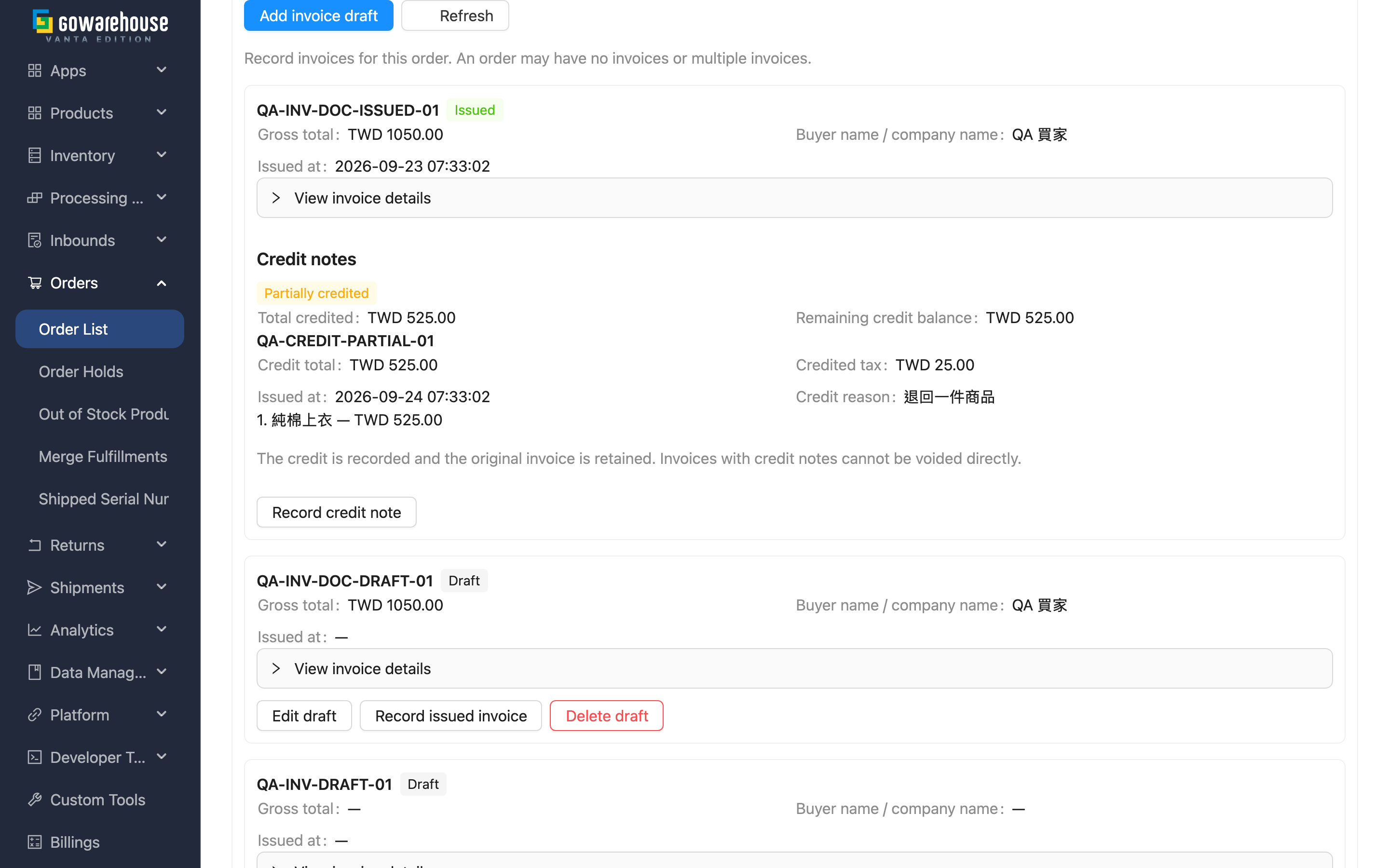
Use the Invoices tab to record external invoices and track issuance, voids, replacements, and credits. An order may have no invoices or multiple invoices. Invoice changes do not affect warehouse fulfillment.
With order write permission, click Add invoice draft to add a draft. The order’s buyer details, currency, and items are prefilled. Blank buyer name, address, or phone fields fall back individually to the recipient name, full delivery address, or delivery phone. These values remain editable. The draft also prefills the owning merchant’s seller name, tax ID, and address. Complete any missing merchant details. Items use base-unit quantities and order prices. Missing prices or tax rates are not guessed; complete tax settings and amounts against the external invoice.
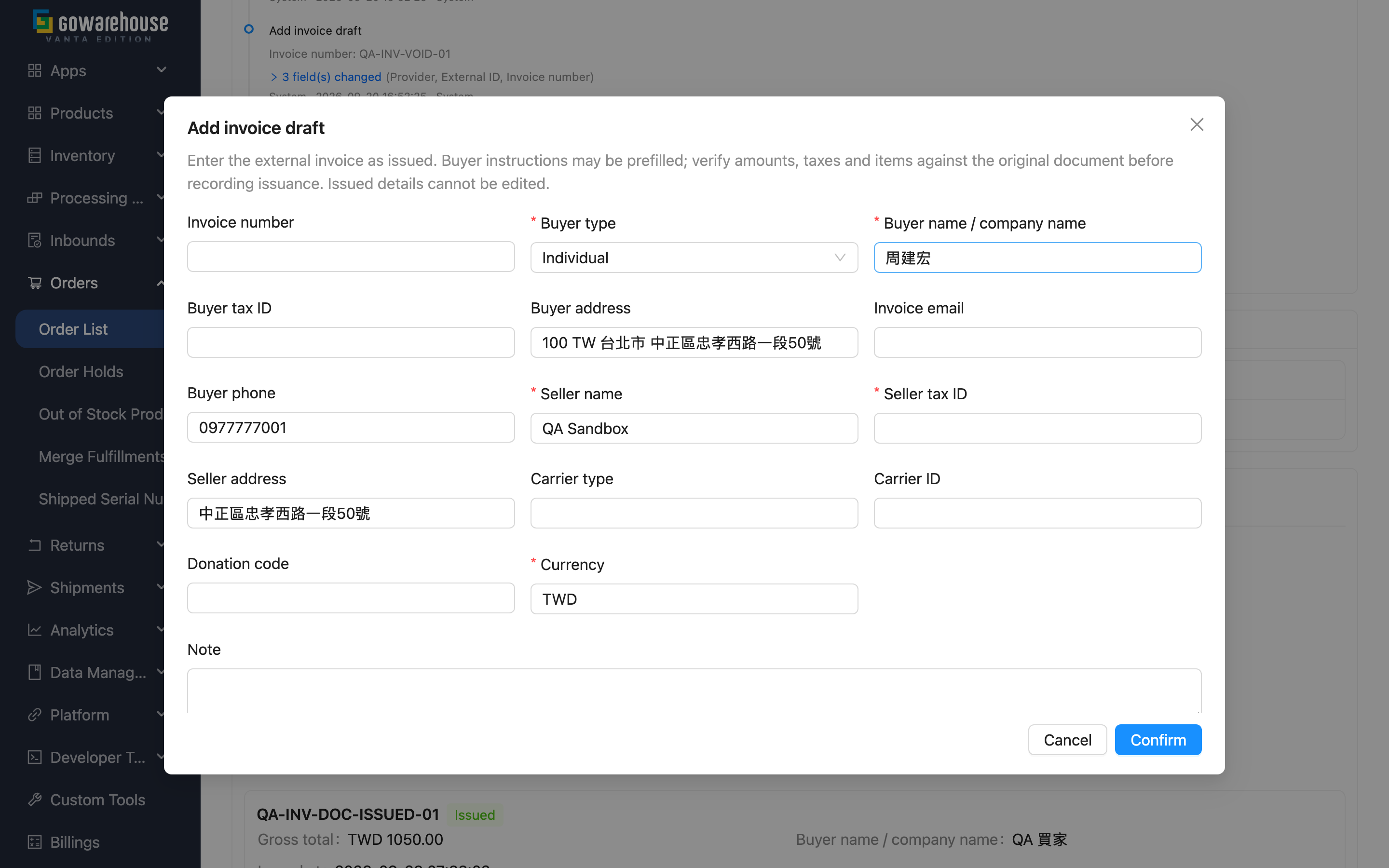
Click Import order items to import again and calculate amounts using the current tax type and rate. If lines already exist, confirm replacement; manual line edits will be overwritten. Check shipping, discounts, and invoice totals separately. Orders with more than 1,000 items cannot be imported in full; add lines manually to match the external invoice. You can also use Add item, edit or remove draft lines, or permanently delete the draft. These actions do not change order products. Editing or replacing an existing invoice preserves its original document instead of automatically importing the order again.
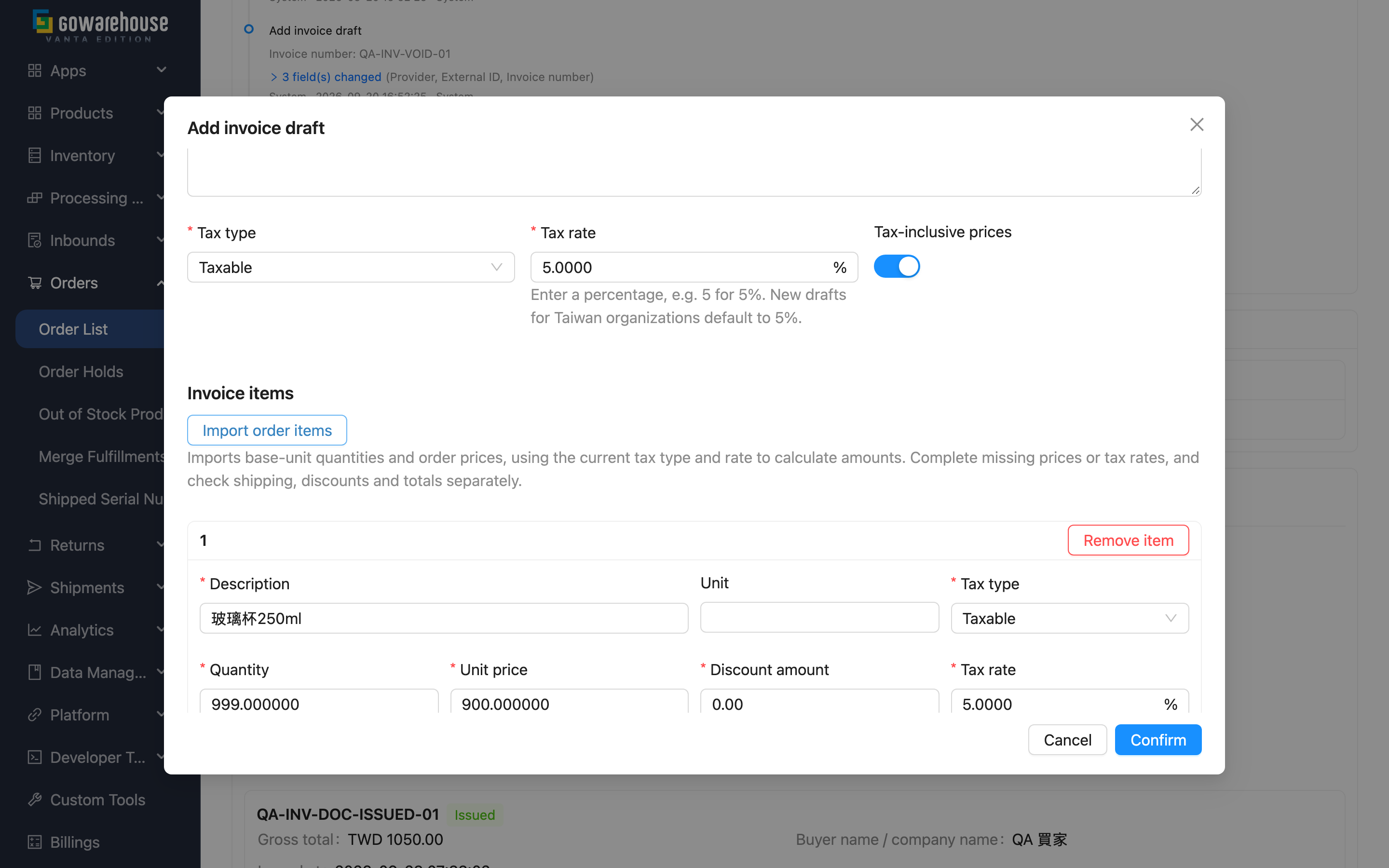
| Field | How to fill it in | Notes |
|---|---|---|
| Invoice number | Enter the original invoice number, including leading zeros | Optional for drafts; required to record issuance. Maximum 255 characters |
| Currency * | Enter a three-letter uppercase code, such as TWD | Credit notes use this currency |
| Tax rate | Enter a percentage, such as 5 for 5%. New drafts for Taiwan organizations default to 5%; other or unknown countries leave it blank | Enter 0 for exempt or zero-rated lines. Mixed-tax headers may leave this blank; each line still requires a rate |
| Invoice items * | Enter description, quantity, price, discount, tax type, rate, and net/tax/gross amounts | Between 1 and 1,000 lines; positive quantities; up to six decimals for quantity and price, two for amounts |
| Issued at * | Enter the actual issue time | Required when recording issuance |
| Void reason * | Explain why the external invoice was voided | Required when recording a void; retained afterward |
| Voided at * | Enter the actual void time | Must not precede the issue time |
Changing line quantity, price, discount, tax rate, or tax inclusion automatically recalculates tax, gross amounts, and invoice totals. Editing a net amount also updates tax and gross amounts. Header tax type or rate changes apply to all lines; mixed tax preserves individual line settings and sums their amounts. Shipping and invoice discounts use the header rate. When mixed tax makes the adjustment rate unknown, totals are left blank: complete them against the external document and use Calculate totals from items and tax to check them. Calculated values remain editable; verify consistency with the lines before saving.
Only gross totals are compared: item gross totals plus tax-inclusive shipping minus tax-inclusive discounts are checked against the header gross total. If they differ, Amount check warning appears without blocking registration of an issued invoice. Expand View invoice details to see header amounts, comparison amounts, and differences. Original amounts are preserved rather than replaced with calculated values. Check with the issuer; do not issue another invoice because of this warning. Differences in net/tax allocation or rounding do not generate separate warnings. For tax-exclusive pricing with shipping or discounts, the comparison is skipped because the actual tax on those adjustments is unavailable. Gross totals are still compared when both adjustments are zero. Warnings are recalculated after draft corrections; issued documents remain immutable. Basic checks still enforce valid amount formats, nonnegative values, and net plus tax equaling gross within each header and individual line.
After issuing the invoice in your invoicing service or ERP, click Record issued invoice, review the document, and enter its number and actual issue time. Buyer, seller, lines, amounts, number, and issue time become immutable. Use View invoice details to inspect them. Legacy number-only invoices without complete lines and amounts cannot receive credits or be completed after issuance.
To void an invoice, complete the external void first, then click Record void, check the number and amount, and enter the reason and time. A void cannot be undone. Use Create replacement draft on a voided record to copy its document and lines into a new draft with a new invoice number. The replacement links to the original, which is retained. Cancelling an order does not automatically void invoices.
After completing a credit externally, click Record credit note on an issued invoice with complete lines, currency, and remaining balance. Enter the credit number, reason, actual time, and net and tax amounts for each credited line; leave other lines at 0. Use remaining line balance fills a line's full remaining balance. Confirmed credits cannot be edited or deleted. Credit notes, cumulative totals, and remaining balance appear under the original invoice.
Multiple partial credits are supported. Cumulative net, tax, and gross amounts cannot exceed the original invoice or any line. Credits must reference invoice lines; shipping recorded only at header level cannot be credited separately. Registration is unavailable once all line balances are exhausted. A fully credited invoice remains issued. An invoice with credits cannot be voided directly. Order cancellation or returns do not automatically record credits, and credits do not change stock, payments, or refunds.
These actions only record facts already completed externally; they do not send issuance, void, or credit requests to a provider. If the data has changed, close the dialog and refresh the list before retrying. After a credit network error, retry with unchanged values. Before changing values, close the dialog, refresh, and check that no successful record exists to avoid duplicates. Invoice actions and credit registration appear in the order history.
2. FAQ
2.1 FAQ
▪ Why does one order have multiple fulfillments?
When products in the order are spread across different warehouses, some are out of stock and the in-stock ones ship first, or it's merged with another order to the same receiver, the system splits the order into multiple fulfillments. Each fulfillment is an independent shipping operation, shipped and tracked separately.
▪ What's the difference between "Expected Quantity" and "Shipped Quantity"?
"Expected Quantity" is the quantity the customer ordered; "Shipped Quantity" is the quantity actually shipped. When they differ, that item still has a portion unshipped (possibly out of stock or split).
▪ Why is "Edit" unavailable?
An order in a merged fulfillment shows a disabled edit button. Click "Remove from merge" in the page header and confirm to remove this order from all shared fulfillments, then use "Edit". Each shared fulfillment creates a separate fulfillment dedicated to this order. Other orders keep their original merged fulfillments, and reserved inventory stays unchanged.
The button is disabled when the order state does not allow splitting. Removal is also blocked if a shared fulfillment already has a shipment or active picking work, or involves cash on delivery. If amounts cannot be safely apportioned, an error is shown and the entire operation remains unchanged.
For orders without shared fulfillments, action buttons show by status. When the order has entered warehouse picking (fulfillment is "Processing") or is fully shipped, the edit button is hidden automatically to prevent changing content already in process or shipped.
▪ The order address or store code is wrong, but the order isn't editable — what do I do?
When the order has progressed too far to be fully edited, you can hold the order first, then use "Correct Information" to edit fields such as receiver, phone, address, and store code (which don't affect items), then release the hold.
▪ What is the "Logs" tab for?
When the order came in via an e-commerce platform or external system integration, this records the data exchange with that platform, for troubleshooting sync issues. Manually created orders won't have such records.
If a webhook delivery row shows "Failed" or "Awaiting Retry", a "Retry" button appears on that row so you can resend it without leaving the order. The row turns to "Awaiting Retry" immediately; the system resends in the background, and that row's delivery status and "Retries" refresh automatically within about ten seconds. If they haven't updated by then (the target timed out, or this attempt failed again and was queued for the next automatic backoff), reload the page to see the latest result. Both your manual resend and the system's next scheduled retry go to the webhook's current URL: after you correct a wrong address, rows still sitting at "Awaiting Retry" switch to the new address on their own, with nothing to handle row by row; rows already at "Failed" are no longer retried automatically and still need this button. Expand the row to see the address each attempt was actually sent to — that is how you tell a target that never answered apart from one you were still calling at a retired address. Delivered webhooks, and rows from platform integrations or the Partners API, do not get this button. If a webhook fails 10 times in a row the system deactivates it and notifies you; while it is deactivated none of its rows show this button — reactivate it on the webhook settings page (reactivating resets the consecutive-failure count) and the button comes back.The action requires the "Logs - Write" permission.
▪ After copying a platform order, does the copy follow address changes or cancellations made on the platform?
No. Platform-side address changes, item changes, and cancellations apply to the original order only; the copy is already detached from the platform, so every change to it has to be made in the system. Shipping the copy also does not report the tracking number back to the platform. How to tell: orders whose "EC Account" field carries the "Not linked to platform" tag are exactly these — see Copied orders are no longer linked to the platform.
▪ A shipment shows as deleted — what happened?
When editing an order, the system rebuilds the unshipped fulfillments and voids the original shipments along with them; these voided shipments remain in the list marked as deleted for historical reference.
▪ One parcel in "Parcels" has no consumables — was something left unpacked?
No. When a fulfillment ships without ever being packed by the warehouse, the system automatically generates one parcel containing the products and quantities actually shipped; that parcel has no consumables and no recorded weight or dimensions. Seeing this is a normal record, not a sign that something was left unpacked.
▪ Generating the shipping detail PDF reports "The selected order has no fulfillments, so this operation cannot be completed." — what do I do?
The PDF is generated from the fulfillment. If the order still contains items that have not been mapped to actual products (the item list marks them "Unknown Product"), the system does not create a fulfillment for this order, so there is nothing to print. Go to the item list, click "Map This Product" to map the item to an actual product, and try again once the fulfillment is created.
2.2 Notices
⚠️ Important reminders
- Editing an order voids the unshipped fulfillments and their shipments and reallocates inventory, even if you only change one field
- Holding an order only pauses shipping; it does not cancel the order — to terminate an order, run cancel
- A fully shipped order cannot be edited or canceled; to adjust it, use the return flow
💡 Tip: When a customer calls to chase a package, check the shipment tracking number and delivery status in the "Fulfillments" tab to report the current progress.
3. Related Features
| Feature | Description | Link |
|---|---|---|
| Order List | Return to the list of all orders | Go |
| Edit Order | Modify the content of an unshipped order | Go |
| Add Order | Create an order manually | Go |