
Purchase Order List
Feature Not Yet Available
Purchase order management (purchase orders and suppliers) is not currently available on any plan — the corresponding menu items and this page are hidden. Existing data is unaffected and remains intact in the system. This feature will be offered later as an add-on module, at which point the workflow described on this page will apply as-is.
Table of Contents
1. Use Cases
Quick links: Scenario 1: Restock for a merchant and track it through to receiving | Scenario 2: Send purchase amounts to a supervisor for approval | Scenario 3: Watch overdue deliveries and chase suppliers
Scenario 1: Restock for a merchant and track it through to receiving
Situation: A best-seller for one of your merchants is about to run out. You need to order another batch from the supplier and follow it all the way from order placement to the goods physically arriving in the warehouse, so you never run out of stock.
Use this feature: Open a purchase order for this merchant (see Create Purchase Order) recording the supplier, items, quantities, and unit prices. Then return to this list and use the "Status" column to track where each order stands, and the "Linked Inbound No." / "Received At" columns to see whether the latest batch has arrived.
Result: Every order placed with suppliers for this merchant is gathered on one page — which are still awaiting approval, which are approved and awaiting receipt, which are partially or fully received — so restocking progress is clear at a glance.
Scenario 2: Send purchase amounts to a supervisor for approval
Situation: Purchasing involves payment amounts. The merchant wants orders placed by buyers to be confirmed by a warehouse supervisor before they take effect, to avoid wrong quantities or amounts.
Use this feature: The buyer creates a purchase order and submits it for review. The supervisor filters by "Status" for "Submitted" orders and opens each detail page to approve or reject.
Result: A purchase order stays in pending review until approved, and both approvals and rejections are logged — giving the purchasing process a clear audit trail.
Scenario 3: Watch overdue deliveries and chase suppliers
Situation: A few orders were approved long ago and their expected delivery dates are near or past, but the goods still haven't arrived. You want to proactively contact the supplier to chase the shipment before it disrupts the merchant's downstream fulfillment.
Use this feature: Use the "Expected Delivery" filter to single out orders due in that window, combined with "Status" to lock onto orders not yet fully received (approved, partially received).
Result: All orders that should have arrived but haven't are listed, so you can chase suppliers on the overdue ones.
2. Features
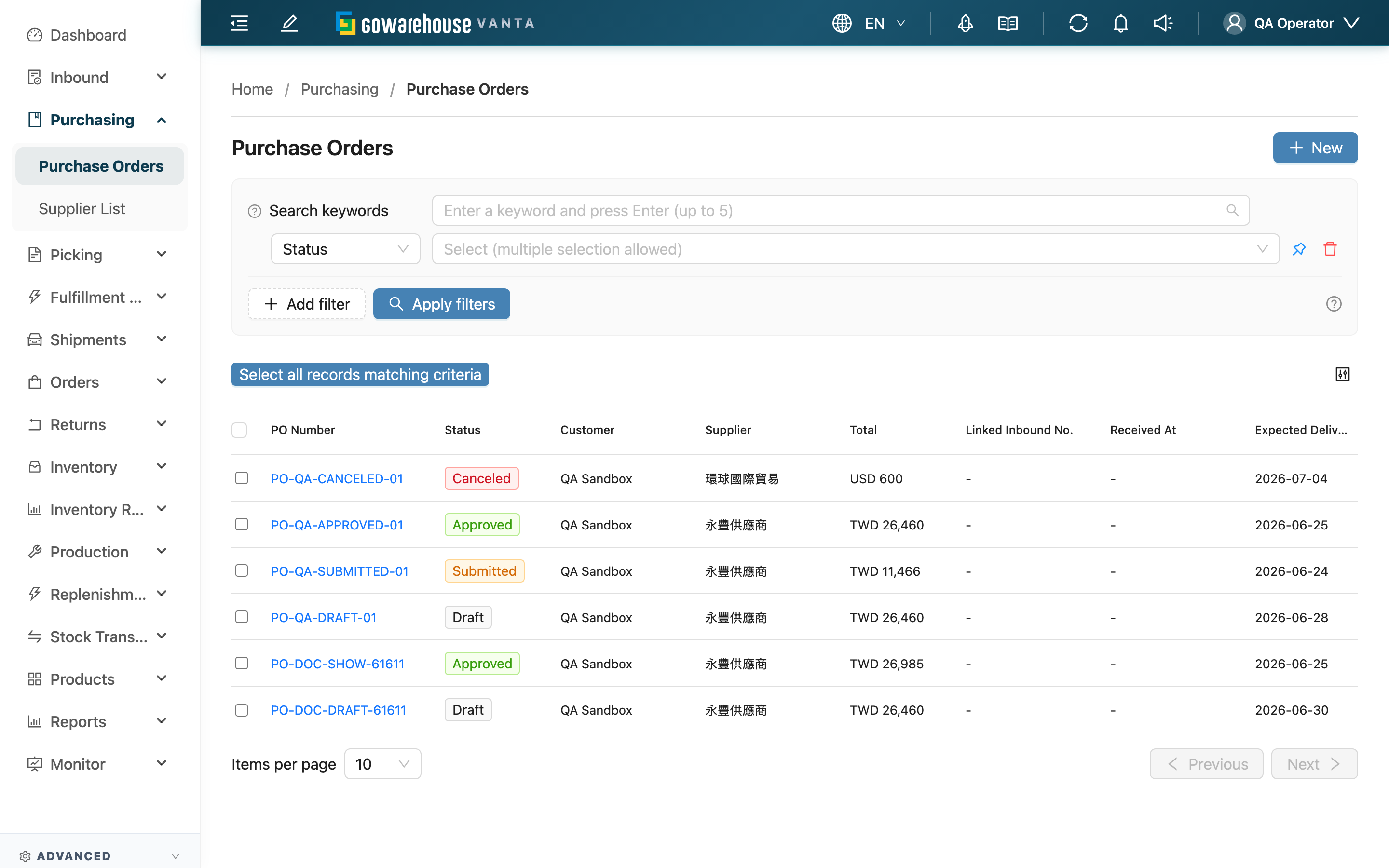
A purchase order records one inbound purchase a merchant places with a supplier: the supplier, which products to bring in, the quantity and unit price of each, and the total amount. The full flow is "create order → submit for review → supervisor approval → create a linked inbound to receive goods on arrival → close"; the order's status advances automatically along this flow, while delivery progress comes from its linked inbounds. This page is the overview of all purchase orders, where you can track each order's status and delivery progress, create new orders, and bulk-export for reconciliation.
Quick jump: Search & filter | List columns | Bulk export
Open it from the left menu: "Purchasing" → "Purchase Orders".
2.1 Search & Filter
The search box matches the leading characters of "PO Number" or "Supplier". Filters are:
| Filter | Description |
|---|---|
| Status | Filter by order status, multi-select (seven statuses listed under List columns) |
| Customer | Filter by which merchant each order belongs to, multi-select |
| Supplier | Select suppliers from the dropdown, multi-select |
| Created At | Filter by order creation date range |
| Expected Delivery | Filter by expected delivery date range |
| Received At | Filter by the linked inbound's receiving time range |
| Linked Inbound No. | Filter by linked inbound number |
2.2 List Columns
| Column | Description |
|---|---|
| PO Number | Purchase order number; click to open the Purchase Order Detail |
| Status | Current status, shown as a colored tag |
| Customer | Which merchant this order belongs to |
| Supplier | The supplier of this order |
| Total | Tax-inclusive total, prefixed with the currency |
| Linked Inbound No. | The most recent linked inbound's number; click to open it. Shows "-" when no inbound exists yet |
| Received At | The most recent linked inbound's receiving time |
| Expected Delivery | The expected delivery date agreed with the supplier |
| Created At | Order creation time |
Status colors:
- Gray: "Draft" — just created, not yet submitted; only this status can be edited
- Orange: "Submitted" — submitted, awaiting supervisor approval
- Green: "Approved" — approved, ready to create inbounds for receiving
- Blue: "Partial Received" — some items received into the warehouse
- Cyan: "Received" — all items received into the warehouse
- Gray: "Closed" — closed, no longer processed
- Red: "Canceled" — canceled
💡 Tip: Frequently used filters can be pinned above the list with "Pin this filter", so you don't have to reselect them next time.
2.3 Bulk Export
After selecting one or more purchase orders, an "Export" button appears above the list. Clicking it generates an Excel file you can download once ready — handy for month-end reconciliation with suppliers. Export is read-only and changes nothing on any purchase order.
The file contains two worksheets: the first, "Purchase Order", has one row per item and matches the list; the second, "Invoice Details", has one row per invoice and adds the due date and outstanding amount, so you can sort by due date to see which invoice falls due next (voided invoices leave the outstanding amount blank, so they are excluded from an outstanding-column total; their invoiced and paid amounts are still shown in full, so totals for those two columns will exceed the cumulative figures on the purchase order detail page by the voided portion. Purchase orders without invoices do not appear on this sheet).
3. FAQ
3.1 FAQ
▪ How does the purchase order status flow work?
"Draft" becomes "Submitted" after submission, and "Approved" after a supervisor approves. Then, as goods arrive and you create linked inbounds to receive them, it advances automatically by received quantity to "Partial Received" or "Received", and is finally closed manually to "Closed". It can still be canceled while in draft, pending review, or approved (as long as no inbound has been created yet).
▪ Why can't some purchase orders be edited?
Only orders in "Draft" status can be edited. Once submitted, an order is locked to prevent its contents from changing after review or after the order has gone to the supplier. To change a submitted order, reject it back to draft (see Purchase Order Detail) or cancel it and recreate.
▪ How does a purchase order become "Partial Received" or "Received"?
Not by manual change. After you create a linked inbound for an approved order and the warehouse actually receives the goods, the system advances the status by each item's received quantity: not yet complete is "Partial Received", fully received is "Received". The entry point for creating an inbound is on the Purchase Order Detail.
▪ What are "Linked Inbound No." and "Received At"?
A purchase order can arrive in several batches, so it can link to multiple inbounds. These two columns show the number and receiving time of the most recent linked inbound, so you can quickly see the latest batch's progress. For the full list of linked inbounds, open the Purchase Order Detail.
▪ Why can't I see the approve / reject buttons?
Approving a purchase order requires an additional approval permission (different from ordinary create/edit permissions). If you can't see the approve and reject buttons on a pending-review order's detail page, you don't have approval permission — please contact your administrator.
▪ How do I receive a purchase order's goods into the warehouse?
Once an order is approved by a supervisor, go to the Purchase Order Detail, click "Create Inbound", choose the warehouse, expected arrival date, and the quantity to receive per item to create a linked inbound. After the warehouse receives against that inbound, the order's delivery progress and status update automatically.
▪ How do I export purchase orders for reconciliation?
Use "Supplier" and "Created At" to narrow down the range to reconcile, select them, and click "Export". See Bulk Export.
▪ Can purchase order numbers be duplicated?
No. Purchase order numbers must be unique within the same merchant. When creating an order, you can click "Suggest Name" to have the system generate a unique number.
3.2 Notices
⚠️ Important
- Only "Draft" can be edited; to change content after submission, reject or cancel and recreate first
- Cancel and close are both irreversible — once canceled or closed, an order cannot return to a previous status
- A purchase order that already has a linked inbound cannot be canceled; use early close to handle the remaining undelivered items
💡 Tip: Regularly filter by "Expected Delivery" for orders due soon or overdue to catch delays early and proactively chase suppliers.
4. Related Features
| Feature | Description | Link |
|---|---|---|
| Create Purchase Order | Create a new purchase order with a supplier for a merchant | Go |
| Purchase Order Detail | View a single order, approve / receive / close, and create inbounds | Go |
| Edit Purchase Order | Edit a purchase order still in draft status | Go |
| Inbound | The inbound used to actually receive goods after the order arrives | Go |